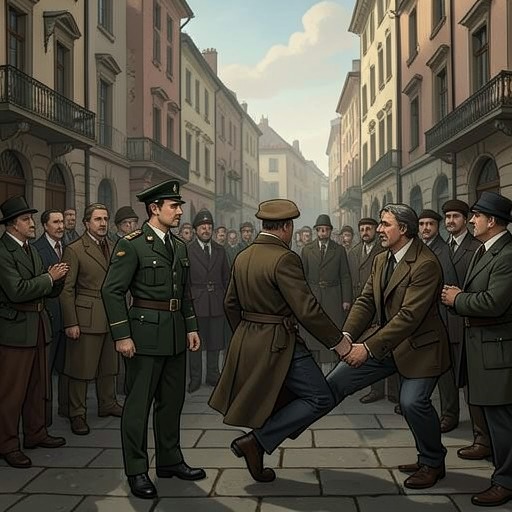
Arrest of Alfred Dreyfus
An Officer and a SpyThe Arrest of Alfred Dreyfus was a carefully staged operation inside the War Ministry, designed to secure its target before news of his detention could spread. The officers used Georges Picquart, whom Dreyfus knew and trusted, to lead him into a room where Colonel du Paty de Clam could elicit a handwriting sample without warning. The resulting arrest did not resolve the disagreement over the evidence: it made the disputed bordereau the centrepiece of a trap, and began a course of imprisonment and public humiliation that the eventual restoration of Dreyfus’s name could not undo.
Planning the Arrest
A telegram summoned Picquart to a meeting at Hôtel de Brienne at six o’clock on Sunday, 14 October. In the corridor, he found General Boisdeffre, General Gonse, Colonel Sandherr, officers he did not recognize, a superintendent from the Sûreté, and du Paty de Clam, who had formerly been Blanche de Comminges’s lover. The minister, Auguste Mercier, laid an arrest warrant on the table and asked about the handwriting analysis. One expert from the Banque de France had concluded that the writing was not Dreyfus’s; Alphonse Bertillon, consulted by du Paty, argued that the bordereau contained strong elements of Dreyfus’s handwriting and that its differences were deliberate. The contradictory opinions were known before the arrest was authorized.
Sandherr urged that Dreyfus be kept in custody for at least a week without attracting public attention, claiming that public pressure would otherwise be brought to bear for his release. Du Paty proposed arresting him inside the ministry, where the officers could control the encounter and keep him in their hands. Gonse had already sent Dreyfus a telegram ordering him to attend a duty inspection in Boisdeffre’s office at nine the next morning, and specified that he should arrive in civilian dress so his later appearance at prison would not immediately identify him as an army officer.
The plan depended on Picquart’s credibility with Dreyfus. Du Paty asked him to meet Dreyfus at the main entrance and conduct him personally to Boisdeffre’s office, explaining that the Chief of the General Staff had been delayed. Picquart would then ask Dreyfus to take down a dictated letter, claiming that his own right hand was bandaged. The writing exercise was intended to catch Dreyfus unprepared; once the officers thought they had enough evidence, they would confront him. Superintendent Cochefort and an assistant from the Sûreté would be present, as would Felix Gribelin, the Statistical Section archivist, to record what happened. Major Henry was to be concealed behind a screen. Mercier asked Picquart’s opinion of the proposal, then authorized the operation and signed the warrant.
The Ministry Ambush
On the following morning, Picquart reached the ministry shortly after eight. Du Paty was in the lobby, nervously organizing those involved: Cochefort, his deputy and a clerk believed to be Gribelin were in civilian clothes, while Henry and Picquart wore uniform. Du Paty repeated his instruction that Picquart bring Dreyfus to the Chief of Staff’s office exactly at nine. But Dreyfus arrived fifteen minutes early, wearing a black frock coat, striped trousers and bowler hat, and looking, in Picquart’s description, like a stockbroker. In the crowded lobby he touched his hat in salute and explained that he suspected someone might be playing a joke: he alone appeared to have received the telegram ordering him to attend in civilian clothes.
Picquart nevertheless led him to the office. When they reached the door, Dreyfus asked whether Picquart was coming in too. Picquart said he had just remembered something he needed to do, said goodbye, and walked away. He heard the lock click behind him. The departing officer’s brief withdrawal completed the deception: the man who had brought Dreyfus there was also someone Dreyfus trusted, but he left him alone with the men waiting to arrest him.
Gribelin later described the scene to Picquart. Du Paty said that Boisdeffre had been delayed, indicated his gloved hand, and asked Dreyfus to write down a dictated letter because he had sprained his wrist. Cochefort and his assistant watched, while Gribelin sat opposite. The dictation included technical material, among it the hydraulic brake of the 120-millimetre cannon. Gribelin said Dreyfus’s handwriting grew larger and less regular at that point, as he realized something was wrong. He also recalled Dreyfus’s foot trembling and du Paty accusing him of changing his style; Dreyfus denied the accusation.
Arrest and Its Immediate Stakes
When the dictation ended, du Paty told Dreyfus he was under arrest for treason. Cochefort and his assistant seized and searched him. Dreyfus continued to deny the charge. Du Paty showed him a revolver and offered what Gribelin called the honourable course. Dreyfus answered, “Shoot me if you want to, but I am innocent!” Henry then emerged from behind the screen and took him away to prison. In the same account, Gribelin showed Picquart a thick folder of writing samples. Its first item was the document dictated during the arrest; the other sheets were copies of the bordereau, labelled for exercises performed with the left or right hand, standing, sitting and lying down. Gribelin said Dreyfus had written it a hundred or more times over several weeks.
The arrest thus rested not simply on a spontaneous test but on a broader effort to obtain and interpret imitations of the incriminating document. The crucial scene, however, remained the concealed purpose of the dictated letter: Dreyfus was invited to write without being told that the officers were treating his response as evidence. Even Gribelin’s account of the change in his handwriting records an interpretation imposed by the investigators, not an independent demonstration of guilt. The earlier disagreement between the handwriting experts remained unresolved as the arrest moved the case from suspicion to confinement.
From Private Seizure to Public Ceremony
The arrest initiated a process that later converted the accusation into a public spectacle. At the École Militaire, four thousand men stood on the parade ground as Dreyfus was brought before General Darras. The court’s verdict had imposed lifelong deportation to a fortified enclosure, discharged him from the army, and ordered his degradation. Darras declared, “Alfred Dreyfus, you are not worthy to bear arms. In the name of the French people, we degrade you!” Dreyfus then shouted, “Long live France! I swear I am innocent!” During the march around the courtyard, he repeatedly maintained his innocence as spectators jeered and called him a traitor. The staged secrecy of the arrest and the public exposure of the degradation were opposite scenes in the same effort to establish his guilt before soldiers and spectators.
Years later, when the case returned to court, Picquart was again present as Dreyfus entered the courtroom, visibly aged and physically diminished. The delayed legal reversal came on 12 July 1906, when the Supreme Court of Appeal overturned the Rennes verdict and fully exonerated him. The next day, the Chamber of Deputies voted to restore Dreyfus to the army as a major and award him the Legion of Honour. The arrest’s institutional consequences were not erased by that decision: Picquart, too, was restored to the army, and he returned to the parade ground for Dreyfus’s medal ceremony in the uniform of a brigadier general. The long interval between the locked office door and the later ceremony gives the arrest its significance: a tightly managed act of concealment had set in motion a public wrong that required years of investigation and legal review to undo.